TECHNOLOGY
Our novel galvanic cell
Water starts the cell reaction. The energy comes from the cell materials. This lets a module be stored dry and activated on site.
THE ENERGY MODULE
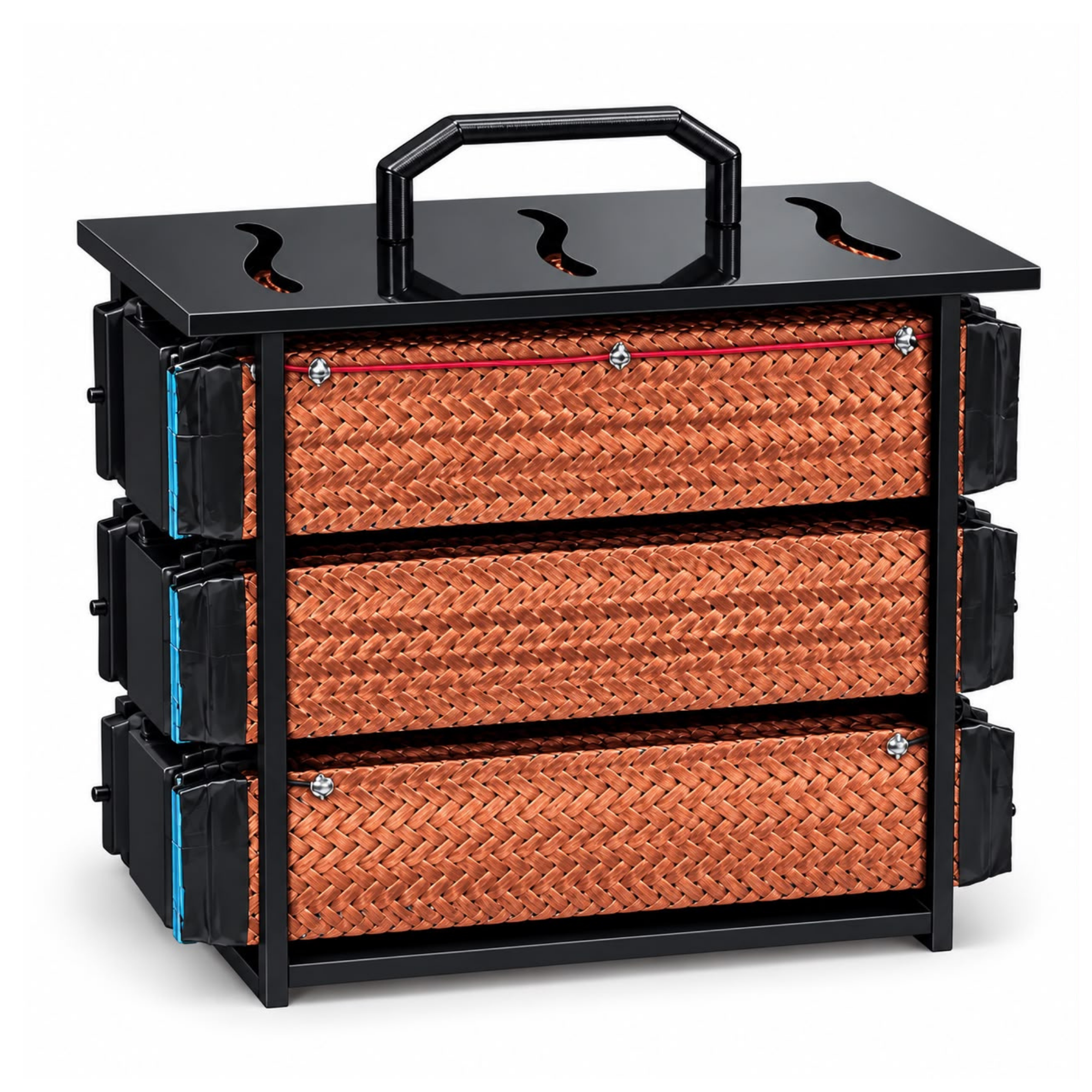
The energy module inside the emergency power case
Several water-activated galvanic cells are connected in this module to form a single energy unit. As part of our emergency power case, it supplies electrical energy to connected equipment.
INSIDE THE CELL
How our cell is built
The metal core supplies the energy. The sponge retains the activating liquid. The outer copper contact connects the cell to the device.
Metal coreSpongeCopper
FROM THE CORE OUT
An alloy of eight metals
The metal core is the sacrificial anode. It consists of an alloy of eight different metals, with no rare earth elements. During the reaction, the anode releases electrons and is gradually consumed.
The sponge retains the liquid
A special blue sponge surrounds the sacrificial anode. It absorbs the water-based liquid and retains it inside the cell, enabling ion transport. How long the sponge stays moist depends on factors including temperature and humidity.
The connection to the device
The outer layer is the flat copper element. It provides the outer electrical contact. Wiring, the switch and the connected device complete the external circuit with the metal core.
TRY THE REACTION
The demonstration starts with a cell that has already been moistened. The movement illustrates the principle.
The circuit is closed
The liquid in the moist cell enables ion transport. Electrons flow through the external circuit and the connected device.
The connected device is switched off
The switch opens the external circuit. A residual reaction of around 7–10% continues inside the moist cell. It stops once the cell has dried out completely.
Fully dry, the reaction stops
Once the activating liquid has fully evaporated, ion transport stops and the residual reaction ends. While usable cell material remains, the cell can be moistened and activated again.
From dry storage to delivering power
Select a step to see what changes inside the module.
Store dry
The cell reaction stays inactive while the module is dry. The module can be stored without self-discharge and activated when needed without advance charging.
Dip and lift out
Dip the module in water or a suitable water-based liquid up to the lower edge of the lid. Lift it out and let any excess liquid drain.
Deliver power
Power is available at the electrical output. The devices the module can power depend on their load profiles and the design of the module.
ACTIVATION LIQUID
Water-based liquids
In principle, any water-based liquid can serve as an activator. Its composition affects how the module reacts and how much power it delivers.
What do we check before use?
Tap water is a reference liquid in our tests. For each module, we check which locally available liquids suit the intended operating conditions.
REACTION CONTROL
What happens when you switch off
A button press switches off power to the connected device. A residual reaction of around 7–10% continues inside the moist cell. It stops once the cell has dried out completely.
The cell delivers power
During operation, the electrochemical reaction continues as long as there is enough liquid and usable cell material.
The cell reaction slows down
A button press switches the module off. A residual reaction of around 7–10% continues inside the moist cell.
The reaction stops
The residual reaction stops once the cell is completely dry. It can be activated again as long as usable cell material remains.
MODULAR DESIGN
More cells for different requirements
Depending on the application, we connect cells in series and in parallel. This allows voltage and available current to be matched to different devices.
Higher voltage
In series, cell voltages add together. A module can therefore be designed for devices that need a higher voltage.
More available current
When matched cells or strings are connected in parallel, the nominal voltage stays the same. The branches share the load and can supply more current together.
Sized for the task
Series and parallel wiring can be combined. We plan to use both to develop energy modules at different power levels, from compact modules to larger systems.
Compare storage and activation
Water-activated module
The cell reaction stays inactive in dry storage. The module can be held in reserve without self-discharge or recharging.
Rechargeable battery
A rechargeable battery is charged in advance. Its state of charge and storage conditions need to be considered when it’s held in reserve.
Frequently asked questions
Where does the energy come from?
Chemical energy comes from the cell materials. The liquid lets ions move through the cell. Electrons travel through the external circuit and power the connected device.
What determines usable energy?
Usable energy depends on the load, runtime, condition of the module and its environment. At system level, the design also needs to account for how cells are connected, voltage regulation and any buffer for power spikes.
Can the same cell be activated more than once?
As long as usable cell material remains, a module can be reactivated by adding liquid. Drying the cell completely stops the residual reaction between uses.
How does the system perform in cold or humid conditions?
The current technology needs oxygen and appropriate airflow. Temperature limits, enclosure protection and suitable ways to activate it depend on the design and testing of each system.
Can results from the case be applied to a pallet system?
Larger systems need separate testing. Alongside cell count, the design must account for liquid and air distribution, heat, electrical safety, logistics and cost per deployment.
How much power does your device need?
Once we know the voltage, power draw and runtime, we can discuss a suitable design.